Standard Class Accommodation
Standard class accommodation

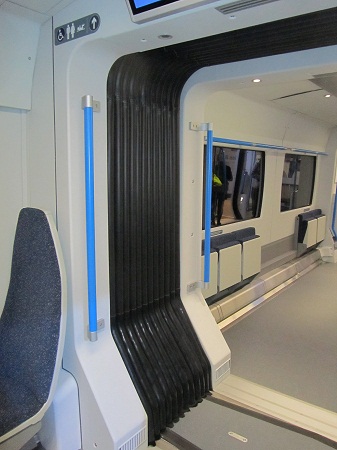
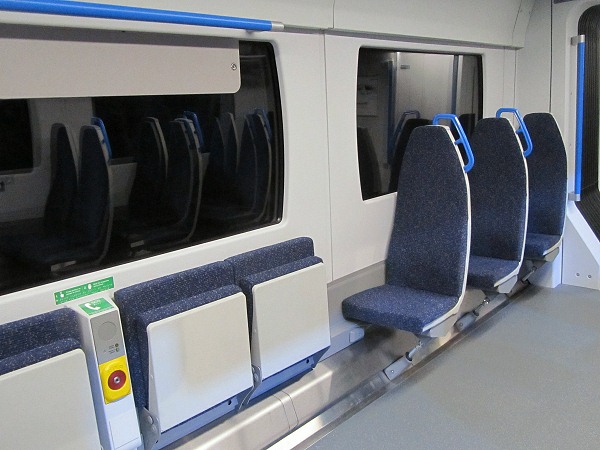
In standard class the seating is also 2+2, mostly in coach configuration, except where a 2+1 layout is required for wheelchair access. For units that will be working long distance services such as Bedford to Brighton - and under TSGN there will be other lengthy workings - the layout is an interesting compromise between inner suburban, outer suburban and long distance, and the comfort of the seats not optimal for lengthy occupation. It will be interesting to see how this works in real life and how popular it will be.

photograph by Colin Duff
Wheelchair position

In reality there were no great surprises - except the clearly high capacity accommodation for long distance services - in these interiors as they are refinements of existing recent train accommodations. The wheelchair position is entirely familiar. On 8 car trains the wheelchair accommodation will be in cars 4 and 5, on 12 car trains in cars 6 and 7. These trains should stop so that the wheelchair accommodation is always in the same position along the platform regardless of train length.

photograph by Colin Duff

Vestibule and luggage rack Full width inter-car connections

As indeed are the door vestibules, luggage racks and full width inter-car connections.

photographs by Colin Duff

A guard's control panel

These units are fitted for both driver only operation or for operation with a guard. Here is a guard's doors and communications panel.

photograph by Ashley Saunders

The wheelchair accessible lavatory and adjacent large luggage rack

As in all modern trains the wheelchair accessible lavatory is the one to use if you want to avoid knocking both of your elbows if you want to turn around! Note the adjacent generous luggage/folding bicycle storage provision - or a generous perch for when the seats are all taken!

photograph by Graham Feakins

Passenger Information System screen

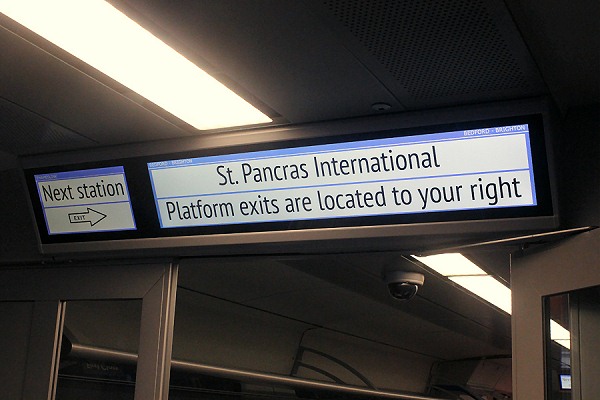
The Passenger Information System (PIS) display was the revelation with LED/LCD monitor type screens replacing the current customary dot LED type scrolling displays. These can display far more information and are more flexible. The above shows a "moving" map for a Bedford - Brighton service approaching Luton Airport Parkway. There is a gap between London Bridge and East Croydon where Thameslink services do not stop! Other displays seen included a next station and which side the doors would open (seen below) and London Underground lines status. However, it will be interesting what specific displays are required to satisfy DDA requirements as the contrast and size of font on some displays, such as the moving map above, clearly do not comply with current legislation.

What is the betting that in service travel information will be interspersed with moving adverts?

photographs (above) Colin Duff and (below) Ashley Saunders

The PIS in next station mode

PAGE 1 ¦ PAGE 3 ¦ PAGE 4