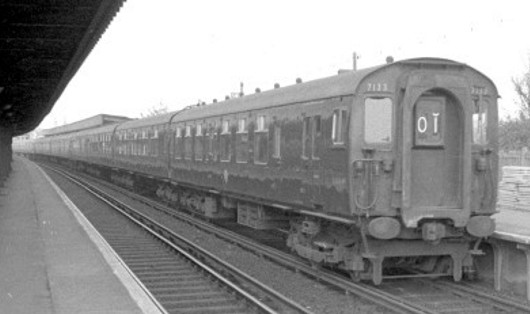
12-car formation with 4 Cep unit 7133 leading at Hither Green in October 1960
© A.J. Wills Collection, Southern Railway Photo Net
|
12-car formation with 4 Cep unit 7133 leading at Hither Green in October 1960 |
Units 7001-7002, 7101-7104 In 1956 the British Transport Commission (BTC, the body to which the Regions of British Railways reported) approved a scheme to electrify the Southern Region main lines to the Kent Coast. The newly electrified main lines would need a large fleet of "express-type" multiple units and six 4-car units were built in 1956 as prototypes to prove the design before large-scale construction commenced. Two of the units included a buffet car and each unit was gangwayed throughout so as to provide passenger access when units operated in multiple to form longer trains.. This concept was similar to the Southern Railway's final main line 4 Cor/4 Buf EMU design - in fact from the customer's point of view the new units were little more than an update of these pre-war fleets. Each unit comprised two driving motor cars with a driving compartment, guard's van area and a seven-bay Second-class saloon with vestibules at each end - BR had re-named Third Class as Second Class when three-class travel on Continental boat trains was abolished; it was later to become Standard Class. Six of the saloon bays had large windows with sliding ventilators above but the central bay had suburban-type external doors - a lesson learnt from the slow loading times of the saloon cars of the Southern's pre-war express units. These two motor cars flanked two trailers. One was a composite, with four First class and three Second class compartments linked by a side corridor. In units 7001-7002 (classified 4 Bep - Buffet Electro-Pneumatic) the other trailer was a buffet car with a pantry, bar counter and loose seating arranged around tables. In units 7101-7104 (4 Cep - Corridor Electro-Pneumatic) the other trailer was an eight-compartment Second Class corridor coach. The new units were based on the BR standard design of main line locomotive-hauled passenger coach, with an all-steel body mounted on an underframe with a central spine. Traction equipment was similar to the EPB suburban fleets though field weakening was used to increase the balancing speed from 63 to 72 mph at the expense of slightly slower initial acceleration. The 4 Cep/4 Bep fleets could work in multiple with all of the EPB types, though mixed formations had to comprise at least 50% express stock with field weakening . Like the Cor/Buf fleets, the unit end design made no concessions to aesthetics - in fact it was simply a standard coach end with windows for the driver and a second person, with a headcode panel mounted slightly off-centre in the gangway door and jumper cables attached. Given the scale of investment in these main line electrifications and the increasing need to compete with the private car, this apparently wilful disregard for customer appeal seems astonishing today. The six prototype units went into service on the Central Division. As they were incompatible with the pre-war Pul/Pan and Cor/Buf units that made up the bulk of Central Division express EMU stock they were initially confined to specific diagrams. Units 7003-7012, 7105-7153 Cep units 7105-7153 and Bep units 7003-7012 were delivered in 1958-59. The first six Ceps joined the prototypes on the Central Division; other units were stored temporarily in a variety of locations until Phase 1 of the Kent Coast electrification was launched in Summer 1959. As well as operating fast services between London and the Kent Coast, the Cep/Bep fleet were the mainstay of "boat train" services from Victoria to the cross-Channel ferry ports at Dover and Folkestone - at that time a large proportion of passenger traffic to Europe was by the "classic" rail-sea-rail routes rather than by air or by car ferry. The units had the same internal layouts as the prototypes but the electrical control gear was of the "1957" camshaft type. The Folkestone Harbour branch, used by boat trains, included a fearsome (by railway standards) 1 in 30 gradient. The production Cep/Bep fleet had a switch, controlled by the driver, to enable the motors to be kept in series, rather than notching up to parallel, when ascending this incline. The BTC was becoming increasingly aware of the need for good industrial design to project a positive image for the industry and, in the same year as the prototype Cep/Bep units entered service, established an advisory Design Panel. The new Design Panel was unable to influence the external design of the production batches of Cep/Bep units (their subsequent work on the generally similar Clacton a.c. EMUs and Inter-City DMUs was to demonstrate that corridor ends are not incompatible with reasonable aesthetics ). However they did help to deliver a brighter, more modern interior with improved lighting and the first appearance of "Trojan" seat moquette, destined to become a BR design classic. The original wood panelling gave way to laminate in steel blue and light grey in the motor coaches, red and green plastic body side panels appeared in the second and composite trailers respectively whilst buffet cars had white panels and stardust brown gangway entrances. All wood framing was now sycamore and all windows double-glazed. Units 7013-7022, 7154-7211 These units were built in 1960-61 for Phase 2 of the Kent Coast electrification. They were generally similar to, and quickly became common user with, the Phase 1 fleet. Ride quality had always been a problem for BR EMUs and for the Southern fleets before them. In an effort to counteract criticism of the rough riding Phase 1 stock, the Phase 2 fleet had "Commonwealth" trailer bogies - a heavy and relatively complex design specifically developed for indifferent track quality. The prototypes and the Phase 1 units had been fitted with double glazed windows, as were some of the later builds of BR standard locomotive-hauled stock, with a view to reducing noise and maintaining a more constant internal temperature. These were prone to condensation problems so the Phase 2 units had single glazing and the double glazed windows of the earlier fleets were progressively replaced. MLVs 68001-68010 Ten Motor Luggage Vans (MLV) were built in 1959 (68001-2 for Phase 1) and in 1961 (68003-10 for Phase 2) to help carry the large volumes of luggage and mail on the boat trains. In particular, these units could accommodate luggage and mail under Customs seal. Each MLV had a driving compartment at each end, a guard's compartment and two van areas, one larger than the other. They were not gangwayed and the cab ends closely resembled the BR standard "EPB" and "Hap" units. Traction equipment was of the "1957" camshaft type and each car had two traction motors with field weakening . As such they were compatible with other stock in the EPB family and normally worked in multiple with 12-car formations of Cep/Bep stock to form boat trains of up to 14 cars. With each MLV having the power output of a 2-car unit, they gave a useful boost for climbing up from Folkestone Harbour. However experience showed that these high-power formations could trip traction power supply circuit breakers so in 1968 six locomotive hauled gangwayed brake vans were fitted with EP brakes and through cabling. These Trailer Luggage Vans (TLV) were marshalled between a single MLV and a Cep/Bep when 14-car trains were required. As well as working in multiple with other EPB-type stock, the MLVs were fitted with batteries to enable them to run independently over unelectrified sidings - the batteries were recharged by a motor-alternator set when back "on the juice". The MLVs were also able to haul a trailing load of up to 100 tons and were fitted with an exhauster and combined brake valves for hauling vacuum-braked stock. In service The Kent Coast electrification scheme did not generate the volumes of traffic originally projected so in 1964 some of the Cep/Bep fleet was transferred to the Central Division, replacing Cor/Buf units on the "Mid Sussex" route from Victoria to Bognor and Portsmouth. "Classic" rail-sea-rail passenger traffic to the Continent declined steadily in the face of competition from airlines and from roll-on roll-off ferries, reducing the volumes of luggage carried on connecting services, and the TLVs were taken out of service by 1975. Under the TOPS scheme the 4 Cep units became Class 411, the 4 Beps class 412 and the MLVs Class 419. Refurbishment In common with other fleets built in the late 1950s and early 1960s the Cep/Beps had large quantities of blue asbestos insulation, later recognised to be a significant health hazard. The asbestos had to be removed under controlled conditions and, as this involved stripping the cars, the opportunity was taken to give them a mid-life update. In 1974 unit 7153 was refurbished at Eastleigh Works as a prototype. The guard's van area in each motor coach was replaced by a small Second class saloon. The trailer second was converted to an open vehicle and a guard's compartment substituted for two of the former second class compartments in the trailer composite. New seating was installed in each car, similar to that in the Mark 2(d) and (e) hauled stock. Double glazing with hopper ventilators and improved gangway connections were installed, along with a public address system and improved lighting. The existing trailer bogies were replaced by "Commonwealth" bogies recovered from locomotive-hauled stock and control equipment was modified to be compatible with "1963 stock" (Cig, Big and Vep). Between 1979 and 1984 the rest of the fleet was similarly refurbished and renumbered 1501-1621. Unit 7153 was overhauled to bring it into line with the production batch and became 1500. Several of the 4 Bep units had their buffet cars replaced with former locomotive-hauled Open seconds, emerging as additional Class 411 units. Only seven were refurbished as Class 412 buffet units. The Hastings line was electrified in 1986 and newly refurbished Class 411s were drafted back into the South-Eastern division to operate these services. Privatisation and withdrawal Under the Railways Act 1993, British Rail was restructured into a large number of subsidiary companies which were then sold to the private sector. BR's rolling stock fleet was divided into three portfolios of approximately equal value and transferred to three Rolling Stock Companies (ROSCOs). The Class 411 and 412 units became part of the Porterbrook ROSCO's assets. 25 Train Operating Companies were set up and offered to the private sector with fixed-term franchises. Under the terms of the South Eastern franchise, won in 1996 by French transport operator Connex, the remaining Class 411 units, then nearing their 40 th birthdays, had to be replaced by new rolling stock. Bodywork corrosion was, by this time, giving cause for concern. Meanwhile, Porterbrook had been acquired by Stagecoach Group, operator of the South West Trains franchise (and the handful of Class 412 units) and a high proportion of units withdrawn by South Eastern accordingly found their way on to SWT services rather than the scrap-heap. By the late 1990s, the 8-car limit on train length on the Hastings line was becoming a problem due to traffic growth. However the platforms at Tunbridge Wells are too short for 12-car trains and tunnels at both ends made platform extension impracticable. Accordingly Connex shortened some of its Class 411 units to three cars to enable 11 car peak formations to operate to Tunbridge Wells - power supply constraints prevented them operating through to Hastings. Railtrack's Byzantine vehicle acceptance procedures held up the entry into service of South Eastern's class 375 and South West Trains' class 444 and 450 fleets and remaining Class 411s soldiered on into the 21st century, the last units being withdrawn in 2005. Several Cep/Bep vehicles and virtually all MLVs have been preserved. |